
Why do Catholics rely on the saints’ intercession?

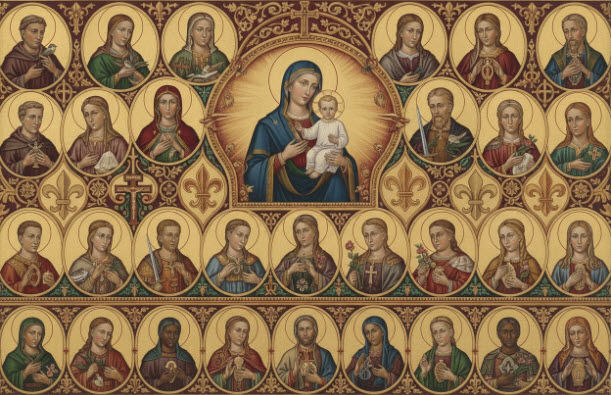
Intercession is a form of petitionary prayer that aligns us with the way Jesus prayed. He stands as the sole intercessor with the Father on behalf of all humanity, particularly for sinners.
Jesus is "able for all time to save those who approach God through him, since he perpetually lives to intercede for them."
The Holy Spirit "intercedes for us... and intercedes for the saints according to the will of God."
Since the time of Abraham, intercession—praying on behalf of others—has been a hallmark of a heart attuned to God's mercy. In the era of the Church, Christian intercession is a participation in Christ's intercession, reflecting the communion of saints. Through intercession, the one who prays considers "not only his own interests, but also the interests of others," extending even to praying for those who may cause him harm.
Catholic Tradition and History
The veneration of saints has been an integral aspect of Catholicism for centuries, originating in the early Church. The Church's recognition of saints, the observance of their feast days, and the establishment of churches and shrines in their honor are deeply embedded in a rich historical tradition.
This tradition fosters a sense of continuity and connection with the Church's historical foundations, enriching the spiritual experience for all Catholics.
In my view, as beings created by God and inherently sinful, the saints in heaven, who possess the beatific vision, are more likely to have their prayers accepted by God on our behalf than our own direct prayers, given our sinful nature.
The Communion of Saints
Saintly devotion is so central to Catholicism that it’s embedded, word for word, in the Apostle’s Creed – which sums up the core beliefs of all the faithful.
Apostles Creed, A.D. 33 *
Credo (Symbolum Apostolorum)
I believe in God the Father Almighty Creator of Heaven and earth; and in Jesus Christ, His only Son our Lord; Who was conceived by the Holy Ghost, born of the Virgin Mary, suffered under Pontius Pilate, was crucified, dead, and buried; He descended into Hell; the third day He rose again from the dead; He ascended into Heaven, (and) sitteth at the right hand of God, the Father Almighty; from thence He shall come to judge the living and the dead.
I believe in the Holy Ghost, the holy Catholic Church, the Communion of Saints, the forgiveness of sins, the resurrection of the body, and life everlasting. Amen.
In Catholic belief, thanks to "the Communion of Saints," the Church is seen as one big family that includes both those on earth and those in heaven, with death not cutting the spiritual ties between them.
It's a core idea in Catholic theology that highlights how all members of the Church are connected, whether they're here on Earth, in purgatory, or up in heaven.
Catholics believe that canonized saints, who are individuals recognized by the Church for their exceptional holiness, continue to be a part of this communion even after death. When Catholics pray to saints, they are reaching out to these holy individuals, seeking their intercession and guidance in their relationship with God.
It should be noted: the Church teaches all people in heaven are saints,
as they have been officially designated as having lived lives of heroic Christian virtue and are thus worthy of imitation and veneration. Saints in heaven have the Beatific Vision (seeing God face-to-face), making their prayers powerful and pure.
Intercession, not worship
As worship is reserved exclusively for God. Thus when Catholics pray to saints, we are asking for their prayers and intercession on our behalf.
Just as you might ask a friend or family member to pray for you during a difficult time, Catholics believe that saints can intercede on their behalf with God due to their closeness to Him.
By doing so, we express our belief in the power of prayer and the understanding that saints can empathize with our struggles.
Saints intercede for us by taking our petitions to God in prayer. Because they are in heaven and completely conformed to the divine will, they amplify our prayers with their own. This acts as an extension of the Christian belief in the "Communion of Saints," where Catholic faithfuls living and in Purgatory support one another.
Jesus remains the sole redeemer; saints simply join their voices to His on behalf of others.
Saints as role models and inspiration.
Another explanation for the practice of praying to saints is because they are role models and sources of inspiration.
Saints are not just abstract figures from the past; they are individuals who led virtuous lives, faced challenges, and overcame them through their faith. Stories of the Saints’ lives serve as a source of inspiration and guidance in our own spiritual journeys.
By praying to saints, we seek to emulate their virtues and gain their guidance in living a more Christ-like life.
Choosing Patron Saints: People often turn to specific patrons whose earthly lives or traditional associations match a current need or profession.
Here are three steps for effective intercessory prayer:
Choose the Right Saint: Pick a saint whose life is inspirational to you, or a patron saint related to your specific need (e.g., St. Anthony for lost items).
Make Your Request: Begin by addressing the saint (e.g., "Dear St. Anthony..."). Clearly articulate what you are praying for and request their intercession. For instance, "Please intercede for me and bring my prayers to the Lord."
Incorporate Structured Prayers: Many individuals include traditional structured prayers with their personal requests, such as a novena (praying over nine consecutive days). You can also offer a prayer that acknowledges the saint’s merits and asks God to listen to them.
The concept functions similarly to asking a trusted friend or family member on earth to pray for you. Rather than replacing Jesus Christ, who remains the sole mediator between God and humanity, saints act as intercessors who present our needs before His throne. This practice, widely maintained in Catholic and Orthodox traditions, is historically and theologically understood through several key elements:
Scriptural Roots: Passages like Revelation 5:8 depict heavenly elders presenting golden bowls of incense to God, representing the prayers of the saints.
Specialized intercessors
Catholics often pray to specific saints who are associated with particular concerns, professions or circumstances.
The following are such examples:
St. Joseph Patron of workers, craftsmen, and people seeking employment.
St. Anthony of Padua is the patron saint of lost items.
St. Paul is patron of missions, writers and publishers.
St. Thérèse of Lisieux is the patron saint of missionaries.
St. Jude is a patron of lost causes and for a medical issues.
St. Peregrine is the patron of cancer patients.
This personalized aspect of devotion to saints allows us to seek intercession for specific needs or challenges we may be facing.
The greatest saint
It has also been proven in many instances that the saints do help us, and the most prominent saint is the Blessed Virgin Mary who is the most deeply revered and frequently invoked intercessor in the Catholic Church, being the Mother of God and spiritual mother to all Catholics.
As the Mother of Jesus Christ, the Son of God, she has a role unlike that of any other saint. Mary’s significance can be understood in several ways:
Immaculate Conception: The dogma of the Immaculate Conception states that Mary was preserved from original sin from the moment of her conception. She went on to live a life without sin, making her a pure and holy vessel chosen by God to bring His Son into the world.
Mother of God: Catholics believe that Mary gave birth to Jesus, who is both fully human and fully divine. This divine motherhood sets her apart and emphasizes her extraordinary closeness to God.
Mother of the Church: At the crucifixion of Jesus, He entrusted Mary to His beloved disciple John and by extension to all believers. In this sense, Mary is seen as the spiritual mother of all Christians, representing the caring and intercessory role she plays in the life of the Church.
When Catholics refer to Mary as the greatest of all saints, it is in recognition of her exceptional virtues, her unwavering faith, and her pivotal role in the salvation narrative. Her “yes” to God’s plan at the Annunciation and her steadfast support for Jesus throughout His life are emblematic of her extraordinary holiness.
Her intercessions have been proven through devotions to the Holy Rosary, the Brown Scapular, and the Miraculous Medal.
This status as the greatest saint is not meant to diminish the importance of other saints but to acknowledge her unique position as the Mother of Christ. Many saints’ holiness can be attributed in large part to their own Marian devotion.


Comments